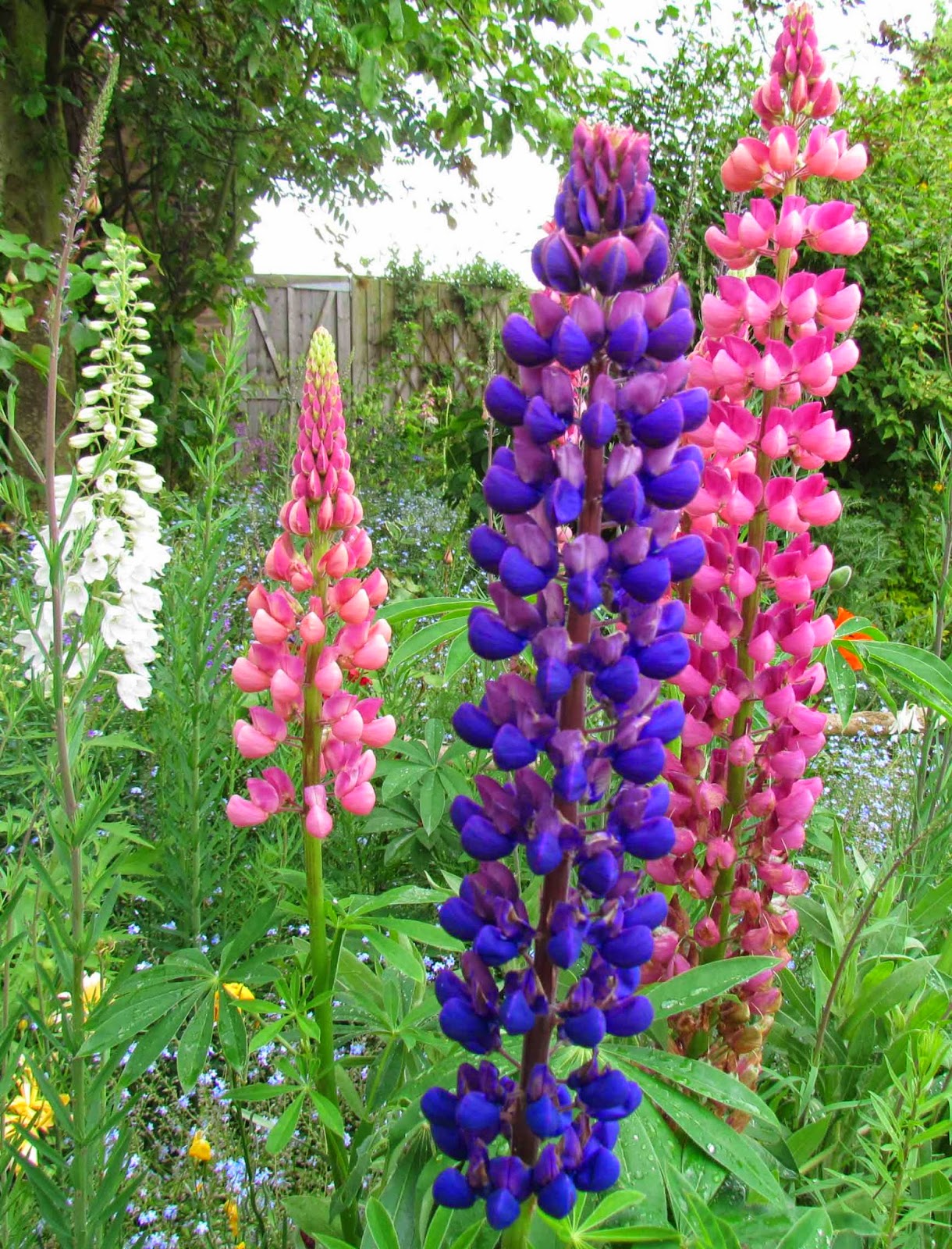
My beautiful allotment lupins have been chewed to bits so I've had to hack them to the ground.

An aphid attack in the garden can be sorted with the hose pipe or soapy water. We don't have a hose pipe at the allotment so when I saw the flowers were being attacked I knocked the spires around and threw lots of buckets of water over them. It didn't work.
My next visit was a couple of days later and the problem was worse. I cut off as many aphid covered leaves as I could and began squashing them but I knew spraying was the only way to kill them. Thinking of the bees I hacked them all down and I'm hoping for new growth.

The problem is I know the aphids will come back. They were lupin aphids. Native to North America they appeared in Britain in the 1980s and have multiplied as only aphids can. Our ladybirds don't eat them so numbers have risen and they are now a real pest all over England.
I've been told to mix 2 cups of vegetable oil with half a cup of washing up liquid to form a concentrate. You then dilute the mixture by adding 1 tablespoon to one litre of water and spray the affected plants. The oil makes the soap stick to the foliage I presume. I haven't tried it personally but I'll give it a go if my lupins survive the chop. Apparently it is important to stick to the dilution ratio or it could cause leaf burn if the mixture is too strong. Oh, and don't use it on sunny days ... leaf burn again.

Lupins belong to the legume family and there are over 200 different species. I knew that, yet I was a little surprised to read that the seeds are edible and can be used as an alternative to soyabeans. High in protein and fibre but low in starch they tend to have a rather bitter taste so sweeter varieties are being developed. They are stored in salt solutions in the same way as olives and are commonly consumed with beer in large parts of Europe and the Middle East.

Lupins are very good for the soil because they improve the nitrogen content.
I just think they look lovely!


